Are all ultra-processed foods bad for you?
Last Updated : 19 December 2025Key takeaways:
- Ultra-processed foods (UPF) cover a huge range of products: from fizzy drinks and sweets to whole grain bread and fortified dairy alternatives. Lumping them all together under one label can be misleading.
- Not all UPFs affect health the same way. Their impact depends on their type, nutritional value and how they fit into your overall diet
- Processed meats and sugary drinks are the UPFs most strongly linked to heart disease, while ultra-processed breads (e.g., those containing food additives such as emulsifiers) or dairy don’t show the same risks.
- Most studies on UPFs and health risks are observational, showing associations but not cause and effect. Lifestyle and diet habits can also influence health outcomes.
- UPFs with good nutritional content can be a practical option when time, cost, or access to fresh foods are limited.
- The definition of UPFs is still debated. Current definitions lack precision and consistency, which makes it difficult to reliably classify foods and interpret research findings.
Ultra-processed foods (UPFs) have gained a lot of attention, especially since the NOVA classification system highlighted their potential connection to poor health outcomes.1 According to NOVA, ultra-processed foods include products made through multiple industrial steps using ingredients not commonly found in home kitchens, like additives, modified oils or flavour enhancers.2 UPFs are often portrayed as the enemy of healthy eating. But is the story really that simple?
Fact: ultra-processed foods vary widely in their nutritional value and health effects, some can provide valuable nutrients and fit into a healthy, balanced diet.
UPFs differ greatly in their nutritional quality and health impacts.3 Some UPFs are nutrient-rich and can fit into a healthy, balanced diet. For example, fortified plant-based milk alternatives provide calcium and vitamin D for those avoiding dairy and whole grain breads and breakfast cereals contribute fibre and B vitamins. Tofu is a great source of high-quality plant protein, while ready-to-eat vegetable-based meals or yoghurt bowls can make balanced eating easier and more convenient. These foods can be part of a healthy, accessible, and sustainable diet, especially when time, cost or availability are limited.
Myth: all ultra-processed foods are unhealthy and should be avoided.
While studies often link higher UPF consumption with poorer health outcomes, these analyses group together very different food products. UPFs range from sugary drinks to fortified breakfast cereals and whole grain breads (e.g., those containing food additives such as emulsifiers). This means their health impact depends less on the fact that they are ‘ultra-processed’ and more on the specific food’s nutritional quality and its role within someone’s overall eating pattern.
Research reflects this variability. A meta-analysis showed that UPFs such as white bread, sugary drinks, and processed meats were linked with a higher risk of type 2 diabetes, while whole grain breads and yogurt-based desserts were linked with a lower risk.4
Another large European cohort study similarly reported that total UPF intake was associated with a higher risk of developing multiple chronic diseases, but the relationship differed by food group: animal-based UPFs and artificially and sugar-sweetened beverages both increased risks, while UPF breads (e.g., those containing food additives such as emulsifiers), cereals, and plant-based alternatives didn’t increase (or decrease) risk.3
A separate meta-analysis also showed that processed meats and sugary drinks were the main contributors to heart disease risk, whereas UPF breads and cereals, yogurts and dairy desserts, and savoury snacks (e.g., fat-free popcorn, crackers) were associated with reduced risk.5
Emerging research also shows that UPFs differ in their impact on gut health. Processed meats, fried snacks, and sugary sweets and drinks can disrupt beneficial gut bacteria, whereas fibre-fortified cereals, whole grain products, and fermented dairy products enriched with live cultures can support the growth and activity of health-promoting gut microbes.6
Importantly, these mixed findings are partly explained by the way UPFs are defined. The NOVA classification system has been criticised for lacking a sufficiently precise and rigorous definition, making it difficult to apply consistently in research. This raises doubts about whether foods have been classified correctly across the many observational studies using this system.
In a 2022 study, food and nutrition professionals were asked to classify 120 foods using NOVA and showed substantial disagreement: for around one third of the foods, classifications varied across all four NOVA categories. This lack of consistency highlights the need for a more precise definition of UPFs for research purposes, as well as a simpler, clearer definition for the general public.7
Fallacy: the belief that all ultra-processed foods are bad oversimplifies a complex issue and overlooks the wide nutritional differences within this group.
Grouping all UPFs together ignores the wide nutritional variety within this category. The relationship between UPFs and health is still being researched, and scientists are exploring several potential mechanisms, including the role of additives, hyper palatability, energy density (the number of calories contained in 100 g of food), satiety and glycaemic responses, and the rate at which energy can be consumed. Processing can also alter the texture and structure of foods in ways that may influence how quickly and how much we eat, which may help explain some of the associations seen between processing and health.8
Next to the potentially undesired consequences of food processing, it can also bring certain benefits. Processing can also improve the bioavailability of certain nutrients, meaning the body can absorb them more easily, as seen with some vegetables such as carrots or tomatoes.
It's also important to interpret UPF research carefully. Most studies are observational, which means they can identify associations but cannot prove cause and effect. For example, if people who eat more UPFs have a higher risk of cancer, this could reflect other lifestyle factors, dietary habits, or socioeconomic conditions that also influence health.
A more practical approach is to focus on specific UPFs consistently linked with harm, such as sugary drinks and processed meats, while recognizing that other UPFs can contribute to a balanced, safe, and sustainable diet. For many people, especially when time, cost, or access to fresh foods is limited, convenient processed products can help meet nutritional needs.
UPF classifications are not currently used in official dietary guidelines in the UK or most European countries. Bodies such as the British Nutrition Foundation (BNF) and the Scientific Advisory Committee on Nutrition (SACN) emphasise that the NOVA system is too broad and inconsistently applied to guide national policy.9 Instead, current dietary advice continues to prioritise nutrient-rich dietary patterns (e.g., dietary patterns higher in fibre, vitamins and minerals, based on nutrient-rich foods such as whole grains, fruits and vegetables, fish, pulses, nuts, seeds, and dairy foods), rather than the level of food processing.
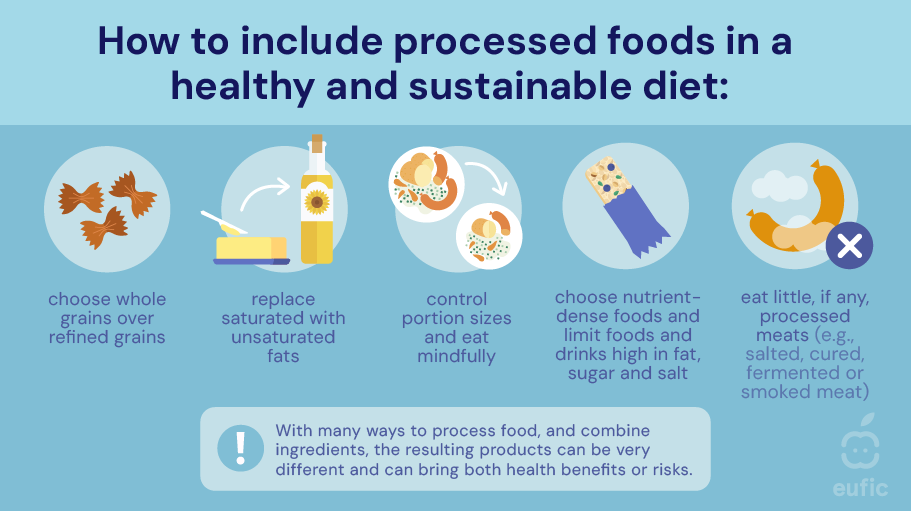
Ultimately, we don’t eat technologies or processing categories, but we eat foods. What matters most is the overall composition of those foods, such as their sugar, salt, fat, and fibre content. To make smarter choices, read food labels, opt for whole grain options, plant-based or lean proteins, control portion sizes, and be mindful of added sugar, salt, and fat.
References
- Dai S, et al. (2024). Ultra-processed foods and human health: An umbrella review and updated meta-analyses of observational evidence. Clinical Nutrition 43(6):1386–1394.
- Monteiro CA, et al. (2019). Ultra-processed foods, diet quality, and health using the NOVA classification system. FAO, Rome, p. 48.
- Cordova R, et al. (2023). Consumption of ultra-processed foods and risk of multimorbidity of cancer and cardiometabolic diseases: A multinational cohort study. The Lancet Regional Health – Europe 35
- Chen Z, et al. (2023). Ultra-processed food consumption and risk of type 2 diabetes: Three large prospective U.S. cohort studies. Diabetes Care 46(5):1335–1344.
- Mendoza K, et al. (2024). Ultra-processed foods and cardiovascular disease: Analysis of three large US prospective cohorts and a systematic review and meta-analysis of prospective cohort studies. Lancet Regional Health – Americas 37:100859.
- Louie JCY (2025). Are all ultra-processed foods bad? A critical review of the NOVA classification system. Proceedings of the Nutrition Society, 1–9.
- Braesco V, et al. (2022). Ultra-processed foods: how functional is the NOVA system?. European Journal of Clinical Nutrition, 76(9), 1245-1253.
- Forde CG (2023). Beyond ultra-processed: Considering the future role of food processing in human health. Proceedings of the Nutrition Society 82(3):406–418.
- British Nutrition Foundation. (2024). The concept of ultra-processed foods (UPF). Position statement. Accessed 25 November 2025.