Beyond food prices: study reveals multiple barriers to micronutrient-rich diets among vulnerable consumers
Last Updated : 07 October 2026Brussels, 7 October 2026 — Having access to enough food does not necessarily mean having access to a nutritionally adequate diet. New research among people experiencing socioeconomic disadvantage in Italy and Poland has found that multiple barriers — from high food prices and transport difficulties to limited cooking facilities and culturally unsuitable food provision — can combine to make micronutrient-rich diets harder to achieve.
The qualitative study, led by the European Food Information Council (EUFIC) as part of the EU-funded Zero Hidden Hunger EU project, involved eight focus groups with 68 beneficiaries of charitable organisations in Trieste (Italy) and Olsztyn (Poland), including food-assistance recipients, refugees and asylum seekers.
Participants described economic, physical, time-related, informational, social, cultural and organisational barriers affecting their ability to access and consume foods rich in vitamins and minerals. These included high prices and competing household expenses, transport and work constraints, inadequate cooking or storage facilities, limited availability through food assistance, concerns about food quality, culturally incompatible food provision, and difficulties accessing professional nutrition guidance.
Importantly, many of these barriers did not occur in isolation. Participants expressed preferences for obtaining micronutrients through foods they perceived as fresh, minimally processed, local or culturally appropriate, while affordability and availability could restrict their ability to act on those preferences.
“Socioeconomically disadvantaged people are disproportionately affected by micronutrient deficiencies,” said Dr Katerina Palascha, Senior Research Manager at EUFIC and lead author of the study. “However, very few studies in Europe have explored the reasons behind this. Our findings show that multiple barriers interact to compromise access to and consumption of micronutrient-rich foods, particularly when limited resources restrict people’s ability to act on their preferences for fresh, minimally processed or culturally appropriate foods.”
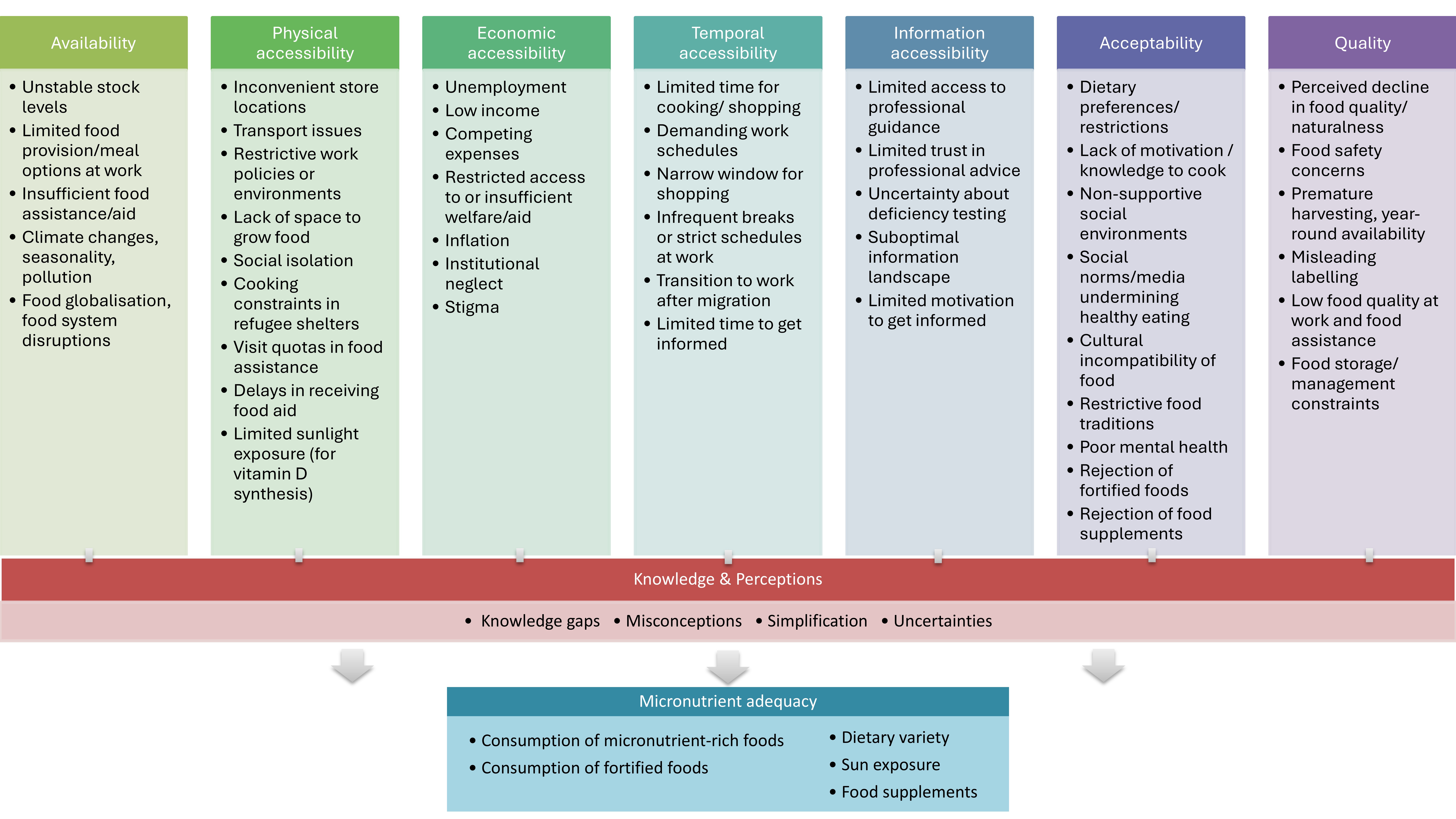
Perceived barriers to accessing and consuming micronutrient-rich foods among food assistance beneficiaries and refugees. Reproduced from Palascha et al. (2026), Foods, under a CC BY 4.0 license.
Different foods, different barriers
The challenges participants described were not the same across all micronutrient-rich foods. Affordability, availability, accessibility and acceptability barriers were particularly reported for foods including fruit, vegetables, fish and meat, suggesting that people experiencing socioeconomic disadvantage may face different obstacles depending on the foods needed to build a varied, nutrient-rich diet.
Participants generally preferred obtaining vitamins and minerals from ordinary foods, expressed predominantly negative attitudes towards fortified foods, and had mixed views on supplements.
The study found differences between the two research settings. Participants in Italy described challenges related to charitable food assistance, including limited availability, accessibility and low perceived food quality, as well as restricted access to professional advice about micronutrients. In Poland, participants highlighted difficulties accessing affordable, high-quality foods in retail settings and navigating nutrition information.
Refugees face additional obstacles
For refugees and asylum seekers, the research identified additional challenges associated with displacement and their living circumstances. These included limited financial and food assistance, restrictions on accessing food or cooking facilities in temporary accommodation, provision of foods that did not match cultural preferences, difficulties navigating unfamiliar healthcare systems and mental-health challenges associated with displacement and experiences of war.
The findings suggest that information campaigns alone are unlikely to address all the barriers identified. The researchers call for context-sensitive responses across areas including food assistance, social protection, public health, organisational food provision and nutrition communication.
The study did not measure participants’ dietary intake or micronutrient status and therefore cannot establish whether individual participants had inadequate nutrient intakes or deficiencies. Instead, it identifies perceived barriers that may increase vulnerability to inadequate micronutrient intake.
ENDS
Notes to editors
Access the scientific paper that was recently published in Foods here: https://doi.org/10.3390/foods15193515
Next steps
EUFIC is currently conducting a follow-up survey of 1,500 people experiencing socioeconomic disadvantage across Italy, Poland and Hungary to examine how widely these barriers extend across Europe. The survey will explore specific issues in greater depth including how information about vitamins and minerals can be presented in ways that are more relevant and accessible to socioeconomically disadvantaged groups.
About Zero Hidden Hunger EU
This research was part of Zero Hidden Hunger EU, a Horizon Europe-funded research project that brings together 19 partners from 12 European countries to estimate the prevalence and health costs of micronutrient deficiencies among high-risk population groups. By providing the best possible evidence, the project supports the development of tailored food focused solutions to eradicate micronutrient deficiencies in Europe.
For media requests, please contact:
Lorena Vargas, EUFIC Media Manager: Lorena.vargas@eufic.org
For further information, please contact:
Katerina Palascha, Senior Research Manager (EUFIC): katerina.palascha@eufic.org
Joint project coordinators:
Prof. Mairead Kiely (UCC) - m.kiely@ucc.ie
Prof. Kevin Cashman (UCC) - K.cashman@ucc.ie
Zero Hidden Hunger EU is co-funded by the European Union under Grant Agreement No. 101137127 – www.zerohiddenhunger.eu