What is food fortification? Benefits, examples and how to spot them
Last Updated : 07 May 2026Key Takeaways:
- Food fortification adds vitamins and minerals to everyday foods, improving their nutritional properties.
- Mandatory fortification is a public health strategy, while voluntary is used by food manufacturers for several purposes.
- Food fortification aims to raise average nutrient intake so most people meet recommended levels.
- Fortified foods help prevent nutrient deficiencies, reduce disease risk, support key life stages like pregnancy and ageing, and meet the needs of special diets such as vegan or vegetarian diets.
- Fortification is safe and highly cost-effective, with low risk when safety guidelines are followed.
- Fortified doesn’t always mean healthy. Any food can be fortified, even those high in sugar or fat, so checking the overall nutrition label still matters.
- To identify fortified foods, you must read the ingredient lists, where added vitamins and minerals are listed.
Walk down any supermarket aisle and you’ll come across foods proudly displaying nutrition claims like “enriched with iron” or “with added calcium.” These products all belong to the world of food fortification. Although often unnoticed, fortification is one of the most impactful nutrition strategies in modern public health. In this article, we will break down what food fortification is, the benefits it offers, whether fortified foods are healthy and safe, and how you can easily spot them on the shelf.
What is food fortification?
Food fortification is the practice of adding vitamins and minerals to foods to improve their nutrient status.1 Food fortification started in the early 20th century as a public health strategy to prevent nutrient deficiencies and support overall health, particularly in vulnerable populations.2 For example, iodine was added to salt in the 1920s to prevent irregular thyroid growth, vitamin D was added to milk to prevent rickets in children in the 1930s, followed by fluoride to drinking water to protect teeth, and most recently folic acid to white (bread) flour, cereal and other grain products to reduce the risk of neural tube defects during pregnancy.3
Today, food fortification is widespread in everyday products serving different purposes. Mandatory fortification is a public health strategy where governments legally require the addition of specific micronutrients like iodine, iron or folic acid to staples to prevent deficiencies.4 Iodized salt is the most common example. In geographical Europe, 22 countries have mandatory salt iodine fortification programmes. Some countries mandate iodine addition only to specific foods or settings. For example, Portugal requires iodised salt in mass catering, while Denmark mandates its use in household salt as well as in bread and other bakery products sold to consumers.5
Voluntary fortification, meanwhile, is chosen by manufacturers to either replace nutrients lost during processing such as B vitamins lost during milling, or to make substitute foods more nutritionally similar to their traditional counterparts, (for example fortification of plant-based beverages with calcium), or to generally improve the nutritional value of products.6
What’s the difference between fortified and enriched foods?
The terms “fortified” and “enriched” are often used interchangeably today, but they mean different things. Enriched foods are those where nutrients that were lost during processing are added back7, like B vitamins and iron added back to flour when the wheat is refined. Fortified foods, however, are products that contain added nutrients that weren’t naturally present, such as vitamin D and calcium added to oat drinks. Regardless of the wording, both practices aim to boost the nutritional value of everyday foods.
What are common methods of food fortification?
- Industrial fortification: Industrial or large-scale fortification is the most common method. Nutrients are added to food during processing. These foods are widely eaten and therefore have the potential to improve nutrition across entire populations.1
- Biofortification: Instead of adding vitamins later, biofortification increases the nutrient content of crops while they’re growing. This can be done through traditional plant breeding, or nutrient-rich fertilizers. Biofortified crops include iron-rich rice, zinc-enhanced beans and wheat, and orange-fleshed sweet potatoes rich in beta carotene (which the body can convert into vitamin A).1
- Point-of-use or home fortification: This method adds nutrients right before eating. A best-known example is micronutrient powders sachets that can be sprinkled on to meals without changing the taste or colour. The World Health Organization recommends them for young children, especially in regions where anaemia is common.8 They’re also used in schools, community programmes, and humanitarian settings. In Europe, this method is rarely used at scale.
- Food-to-food fortification: This emerging strategy uses naturally nutrient-rich foods to fortify others. Unlike traditional fortification which adds isolated nutrients, food-to-food fortification uses whole or minimally processed ingredients as the nutrient source. This usually involves drying, grinding, or powdering nutrient-rich foods (e.g., spirulina, sweet potato flour, mushroom powder, moringa leaf) and mixing these ingredients into starchy staple foods like maize porridge, pearl millet porridge, wheat biscuits, or other cereal products.9
What are the benefits of fortified foods?
Some benefits of food fortification include:
- Reducing nutrient deficiencies: Fortified foods help combat widespread suboptimal intakes to avoid deficiencies which can cause several health issues including impaired cognitive function, weakened immunity, and increased vulnerability to chronic diseases. Micronutrient deficiencies are linked to “hidden hunger,” where people eat enough food but still fall short of sufficient vitamins and minerals to stay healthy.10
- Enhancing public health: Fortification can help in the prevention of several diseases. Μodelling studies suggest vitamin D fortification could contribute to prevent around 27,000 cancer deaths across Europe each year,11 while folic acid fortification in white (bread) flour can help reduce the risk of neural tube birth defects in at least 1,000 pregnancies annually in the EU.12
- Supporting nutrient needs during specific life stages: During pregnancy, fortified foods (like micronutrient-rich drinks) can support healthy foetal growth and reduce risks such as preterm birth and low birth weight.13 In menopausal women and older men, eating foods fortified with calcium and vitamin D can help improve or maintain vitamin D levels and support bone health.14
- Increasing micronutrient intake for those with dietary restrictions or specific dietary needs: Vegetarians, vegans, or people with lactose intolerance face higher risk for deficiencies in specific nutrients such as vitamin B12, calcium, and zinc.15 Fortified plant-based alternatives can give them the nutrients they might otherwise miss.
- Delivering big health impact at a low cost: Food fortification is a highly cost-effective way to improve nutrition, costing only a few cents per person each year while preventing serious health problems.1
Are fortified foods safe?
Fortified foods are generally safe and provide important health benefits.1 Eating large amounts of fortified foods over a long period might lead to getting too much of certain vitamins and minerals that might cause side effects such as nausea, irritability etc. However, this is rare, and the risks are low when fortification is properly regulated.1,6
To ensure safety, organisations such as the World Health Organization and Food and Agriculture Organization of the United Nations have developed guidelines on fortification practices.16 In Europe, the European Food Safety Authority (EFSA) sets upper limits for how much of a vitamin or mineral should be consumed from all sources.
Fortification in the EU is regulated under European legislation. but the specific maximum amounts that may be added to foods are not fully harmonised across Member States. As a result, countries may apply national limits based on EFSA risk assessments.17 European Commission together with seven Member States have been working toward setting harmonised maximum levels for fortified foods, aiming to improve consumer safety and reduce the risk of excessive intakes.18
Are fortified foods healthy?
Fortified foods are designed to boost our intake of vitamins and minerals, but that doesn’t automatically make every fortified product healthy. Nutrients can be added to almost any food, even those that are less-than-ideal. For example, sugary breakfast cereals or energy drinks are often fortified, but adding vitamins doesn’t outweigh the fact that they are high in sugar. For this reason, it’s still important to read labels and look at the overall nutrition of a food, not just the claims “source of vitamins” on the front. Fortified foods can be a helpful boost, but they are best consumed as are part of a balanced diet.
How to spot fortified foods?
Many everyday foods contain added vitamins and minerals, but they aren’t always easy to identify at first glance. Not every product proudly states “fortified” or “enriched” on the front of the package. To know whether a product is fortified, the most reliable place to look is the ingredient list. If a nutrient has been added during manufacturing, it must be listed by name or chemical form on the ingredients list. For example, “vitamin C (ascorbic acid),” “iron (ferrous sulphate),” or “vitamin D (cholecalciferol).” The nutrition label should also present the total amount of the vitamin or mineral in the food, including both what’s naturally there and what’s added through fortification per 100 g.19
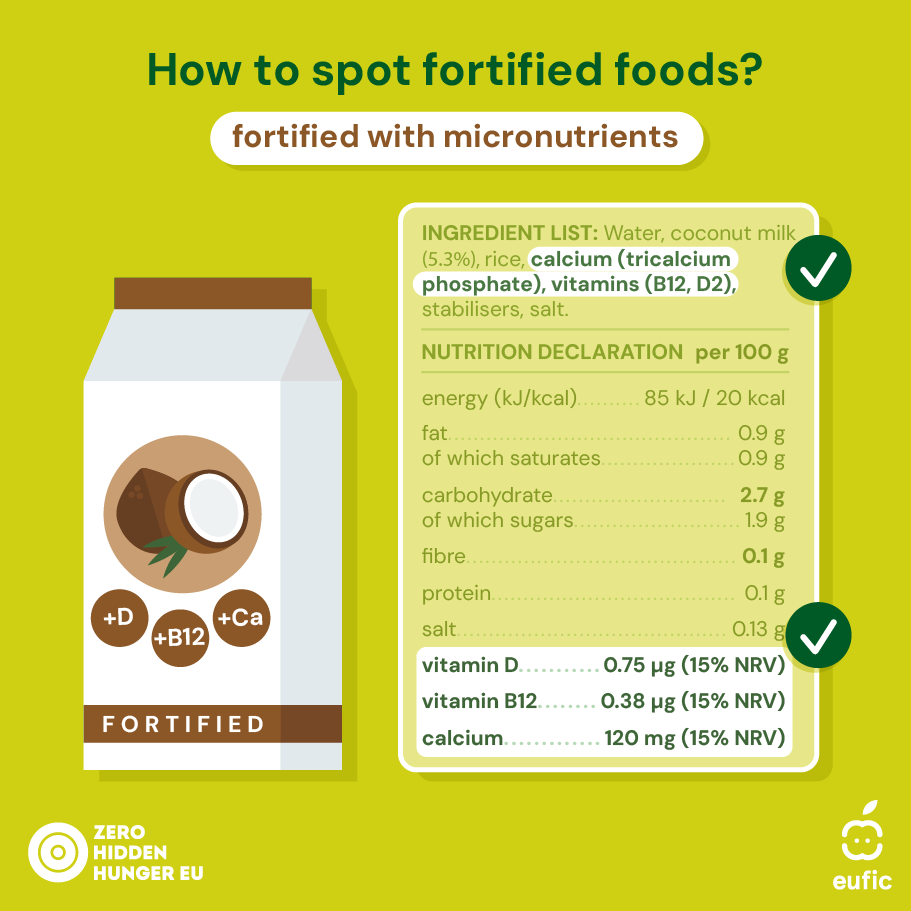
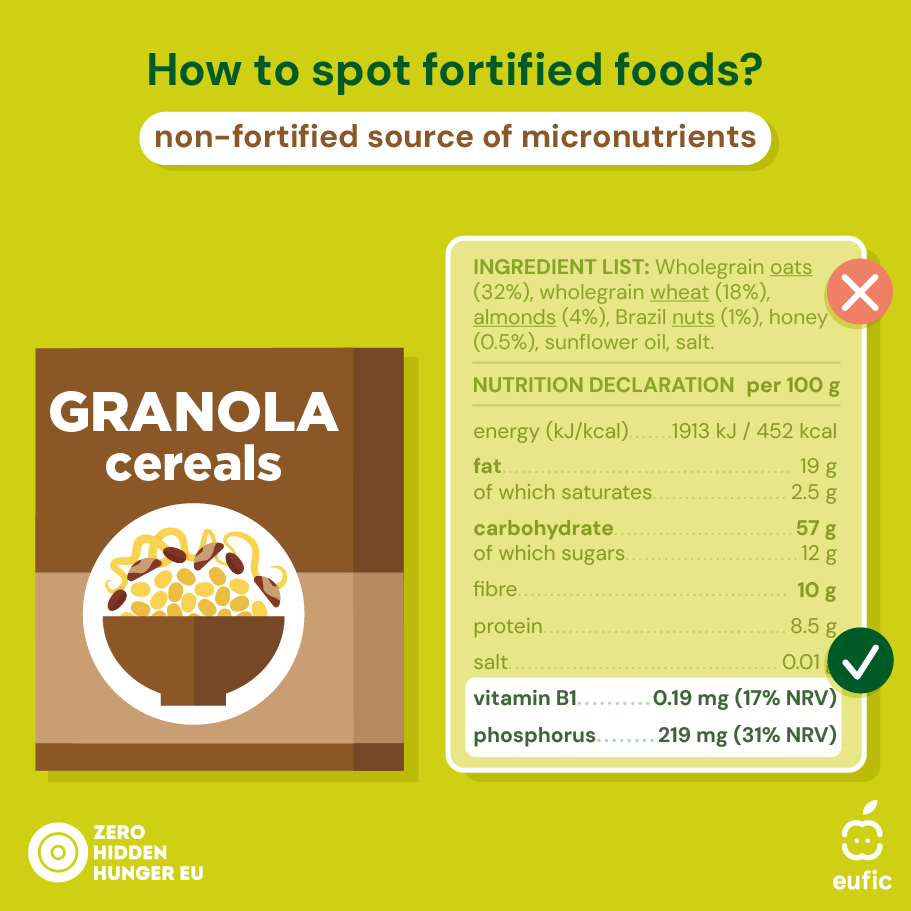
Figure 1 & 2. Where micronutrients appear on food labels. (a) In fortified foods, micronutrients are listed: in the ingredients and in the nutrition declaration. (b) In non-fortified foods, they are listed only in the nutrition declaration.
If a product claims to be a “source of calcium” or “high in vitamin D,” that doesn’t necessarily mean that it is fortified. Many foods naturally contain micronutrients at higher concentrations and nutrient health claim legislation allows manufacturers to promote this.20 This is why checking the ingredient list is useful: if the vitamin or mineral is not listed, the food is supplying it naturally.
Which are the most common fortified foods?
The most common fortified foods are staple foods such as salt, flour and oils that are part of the everyday diet and their enhancement can effectively support the nutritional status.1 In Europe, the product categories most often fortified are dairy, beverages, cereals, baked goods, as well as margarines and spreads.21 Many plant-based drinks are also fortified, with the exception of organic ones.2,22,23
In which fortified foods can you find each micronutrient?
Many everyday foods are fortified to increase (micro)nutrient intake across populations.2,5,22,24,25,26,27
(Micro)nutrient |
Common fortified foods | Countries with mandatory fortification programmes |
|---|---|---|
| Calcium | Dairy, orange juice, breakfast cereals, and plant-based dairy alternatives | UK (non-wholemeal wheat flour) |
| Iodine | Salt, dairy products, and bread | Salt Iodisation: Austria, Bulgaria, Croatia, Lithuania, Montenegro, Poland, Romania, Slovakia, Albania, Armenia, Azerbaijan, Bosnia and Herzegovina, Georgia, North Macedonia, Serbia, Slovenia, Turkey, Belarus, Denmark, Hungary, Moldova, Portugal, Russian Federation |
| Iron | Cereals, flour, rice, and infant formula | UK (non-wholemeal wheat flour), Moldova (wheat flour), Kosovo (wheat flour) |
| Omega-3 fatty acids | Milk, eggs, certain yogurts, and infant formula | — |
| Vitamin A | Milk, margarine, sugar, and oils | Belgium (margarines and spreadable fats) |
| Vitamin B1 (Thiamine) | Bread, pasta, and cereals | UK (non-wholemeal wheat flour) |
| Vitamin B2 (Riboflavin) | Bread, pasta, milk, and cereals | — |
| Vitamin B3 (Niacin) | Bread, rice, pasta, and cereals | UK (non-wholemeal wheat flour) |
| Vitamin B9 (Folic acid) | Flour, rice, pasta, and cereals | Moldova (wheat flour), Kosovo (wheat flour), UK (non-wholemeal wheat flour from December 2026) |
| Vitamin B12 | Breakfast cereals, plant-based dairy and meat alternatives, and nutritional yeast | — |
| Vitamin C | Fruit juices, cereals, and fruit-flavored snacks | — |
| Vitamin D | Milk, orange juice, breakfast cereals, and margarines | Belgium (margarines and spreadable fats), Sweden (milk and fermented milk products, plant-based alternatives, and margarine and fat blends) |
| Vitamin E | Breakfast cereals, plant-based oils, and juices | — |
| Zinc | Cereals, infant formula, and snacks | — |
Summary
Food fortification is a powerful strategy that has improved public health for nearly a century. From iodised salt to vitamin D in milk, it helps reduce the risk of nutrient deficiencies, supports nutrition during key life stages, and benefits people with special diets in a cost-effective way. Fortified foods are safe, but added nutrients don’t automatically make a product healthy, so checking the overall nutritional value still matters. Understanding how to identify fortified products can help you navigate the supermarket shelves with confidence and build a more nourishing, balanced diet.

This article was produced in collaboration with Zero Hidden Hunger EU. Zero Hidden Hunger EU has received funding from the European Union’s Horizon 2020 Research and Innovation programme under Grant Agreement No. 101137127
References
- Olson R, Gavin-Smith B, Ferraboschi C & Kraemer K (2021). Food fortification: the advantages, disadvantages and lessons from Sight and Life programs. Nutrients 13(4):1118.
- Hossain MdS, et al. (2025). Fortified and functional foods: trends, innovations, and their public health impact for future nutrient enrichment. Journal of Agriculture and Food Research 23:102275.
- Deavenport-Saman A, Britt A, Smith K & Jacobs RA (2017). Milestones and controversies in maternal and child health: examining a brief history of micronutrient fortification in the US. Journal of Perinatology 37(11):1180–1184.
- World Health Organization website, ‘Food fortification’. Accessed 20 November 2025.
- World Health Organization Regional Office of Europe (2024). Prevention and control of iodine deficiency in the WHO European Region: adapting to changes in diet and lifestyle. Cophenagen. Denmark. WHO
- Hennessy Á, Walton J & Flynn A (2013). The impact of voluntary food fortification on micronutrient intakes and status in European countries: a review. Proceedings of the Nutrition Society 72(4):433–440.
- Dary O & Mora JO (2013). Food fortification: technological aspects (pp. 306–314). In Caballero B (ed.). Encyclopedia of Human Nutrition (3rd edition). London, UK: Academic Press.
- United Nations Children’s Fund (UNICEF) (2023). Home fortification with multiple micronutrient powders for the prevention of iron deficiency anaemia in early childhood. New York, USA. Unicef
- Kruger J, et al. (2020). What is food-to-food fortification? A working definition and framework for evaluation of efficiency and implementation of best practices. Comprehensive Reviews in Food Science and Food Safety 19(6):3618–3658.
- Ashraf SA (2025). Food fortification as a sustainable global strategy to mitigate micronutrient deficiencies and improve public health. Discovery Food 5(1):201.
- Niedermaier T, Gredner T, Kuznia S, et al. (2022). Vitamin D food fortification in European countries: the underused potential to prevent cancer deaths. European Journal of Epidemiology 37(4):309–320.
- European Commission Joint Research Centre website, ‘Fortification with folic acid could help prevent severe birth defects in at least 1000 pregnancies per year’. Published 6 July 2021. Accessed 28 November 2025.
- Yang Z & Huffman SL (2011). Review of fortified food and beverage products for pregnant and lactating women and their impact on nutritional status. Maternal & Child Nutrition 7(Suppl 3):19–43.
- Whiting SJ, et al. (2016). Food fortification for bone health in adulthood: a scoping review. European Journal of Clinical Nutrition 70(10):1099–1105.
- Bakaloudi DR, et al. (2021). Intake and adequacy of the vegan diet: a systematic review of the evidence. Clinical Nutrition 40(5):3503–3521.
- World Health Organization & Food and Agriculture Organization of the United Nations (2006). Guidelines on food fortification with micronutrients. Geneva, Switzerland: WHO/FAO.
- EFSA Panel on Nutrition, Novel Foods and Food Allergens (NDA), Turck D, et al. (2024). Guidance for establishing and applying tolerable upper intake levels for vitamins and essential minerals. EFSA Journal 22(11):e9052.
- García Gabarra A (2024). Niveles máximos de vitaminas y minerales en alimentos enriquecidos y complementos alimenticios en la Unión Europea. Nutrición Hospitalaria 41(5):1116–1125
- Regulation (EU) No 1169/2011 of the European Parliament and of the Council of 25 October 2011 on the provision of food information to consumers. Accessed 5 December 2024.
- Regulation (EC) No 1924/2006 of the European Parliament and of the Council of 20 December 2006 on nutrition and health claims made on foods. Accessed 5 December 2024.
- FoodDrinkEurope (2022). ‘FoodDrinkEurope proposes guiding principles on the setting of EU harmonised maximum amounts of vitamins and minerals in fortified foods’.
- Xanthopoulou S, Vlassopoulos A & Kapsokefalou M (2025). Foods ‘sources of’ or ‘high in’ vitamins and minerals: fortified or natural? Use of the Greek Branded Food Composition Database (HelTH). Journal of Food Composition and Analysis 144:107721.
- ProVeg International (2024). Building bridges between habit and health, ProVeg International. Accessed 22 February 2026.
- UK Government website (2025). Bread and flour: labelling and composition – Mandatory fortification of non-wholemeal common wheat flour. GOV.UK. Accessed 8 December 2025.
- Itkonen ST, et al. (2020). Vitamin D status and current policies to achieve adequate vitamin D intake in the Nordic countries. Scandinavian Journal of Public Health 49(6):616–627.
- Ghotme KA, et al. (2023). Barriers and facilitators to the implementation of mandatory folate fortification as an evidence-based policy to prevent neural tube defects. Child's Nervous System 39(7):1805–1812.
- Moyersoen I, et al. (2018). Do current fortification and supplementation programs assure adequate intake of fat-soluble vitamins in Belgian infants, toddlers, pregnant women, and lactating women? Nutrients 10(2):223.