Is drinking red wine in moderation unhealthy?
Last Updated : 12 June 2026Key Takeaways:
- Any potential heart-related benefits from red wine are small, scientifically uncertain, and mainly based on observational studies. These “benefits” need to be weighed against the well-documented health risks of drinking alcohol.
- The amounts of beneficial compounds in red wine are very small. To reach the resveratrol doses used in some studies, a person would need to drink hundreds of litres of red wine per day.
- Red wine does contain plant compounds (polyphenols) that can have beneficial antioxidant and anti-inflammatory effects in the body. However, most studies suggesting wine polyphenols benefits are observational, meaning they show statistical patterns, not proof that red wine itself protects the heart. Polyphenols are also found in berries, grapes, vegetables, and many other foods without the health risks that come with alcohol.
- Alcohol increases the risk of several diseases, including cancer, even at low levels of consumption.
- Drinking red wine should not be considered a health strategy, and starting to drink for health reasons is not recommended.
We’ve all heard it: a glass of red wine a day is good for your heart. But thinking twice, drinking alcohol for your health, that sounds too good to be true! Let’s break it down by looking at the fact, the myth, and the inaccuracies behind the popular belief that drinking red wine in moderation good is for our health.
Fact: red wine contains some beneficial compounds, but they do not outweigh the great risks caused by its alcohol content.
Alcohol consumption is linked to a wide range of non-communicable diseases, including liver disease, heart disease, several types of cancer, as well as mental health and behavioural conditions such as depression, anxiety and alcohol use disorders. In 2019 alone, an estimated 474,000 deaths from cardiovascular disease were attributed to alcohol consumption worldwide.1 Alcohol is also classified as a Group 1 carcinogen, meaning there is strong evidence that it causes cancer, no matter how small or rare the exposure is to it.2 Indeed, the World Health Organization suggests that no level of alcohol consumption is safe for our health.2
Myth: drinking red wine is a proven heart-health strategy
The idea that red wine is good for the heart has its origins in the so-called “French Paradox.” Researchers observed that French people had relatively low rates of heart disease despite their diet being rich in cheese (and other foods high in saturated fat), one of the major risk factors for cardiovascular diseases and other diet-related non-communicable diseases.3,4
This observation sparked decades of research. Researchers could partly attribute this paradox due to higher intakes of red wine in France compared to most Western countries.5 Red wine is often seen as potentially beneficial for health because it contains plant compounds called polyphenols, naturally found in grapes. These compounds, particularly resveratrol, have antioxidant and anti-inflammatory properties and have been widely studied for their possible role in heart health. Research suggests polyphenols may support heart health by improving blood vessel function, lowering “bad” cholesterol, and reducing blood clotting, while also helping to regulate blood sugar levels and lower the risk of type 2 diabetes. Some polyphenols are also linked to brain protection, as they may reduce inflammation and oxidative damage involved in conditions like Alzheimer’s and Parkinson’s disease.6-8
But there are important limitations to this idea. First, the amount of resveratrol in red wine is very small, and the body absorbs only a tiny fraction of it. In fact, the amounts found in red wine are far smaller than those used in studies showing potential health effects: to reach a commonly cited therapeutic dose of about 1 gram per day, a person would theoretically need to drink more than 500 litres of red wine, which is clearly impossible.7 For this reason, many researchers agree that the health benefits of resveratrol from wine are often overstated.
Second, it was suggested that alcohol content could be a possible explanation, as moderate consumption can raise levels of “good” HDL cholesterol. This is one reason why wine consumption has sometimes been linked to favourable cardiovascular markers.9-11 But higher HDL levels do not necessarily lead to better heart health: genetic and clinical studies show that increasing HDL cholesterol does not reduce cardiovascular risk, and very high levels may even be harmful.12 In addition, similar improvements in cardiovascular markers have been observed with alcohol-free wine, suggesting that any potential benefits are more likely due to grape-derived compounds rather than alcohol itself.13
Taken together, these mechanisms help explain why red wine has been associated with potential benefits, but they do not prove that drinking it improves health. Any possible advantage must be considered alongside the well-established risks of alcohol.
Fallacy: confusing “association” with “protection” and ignoring the risks of alcohol
A key reasoning error in this myth is confusing association with cause and effect. While several studies have shown that moderate drinkers tend to have lower rates of heart disease, it’s important to understand that most of these studies are observational.14 These studies can identify statistical patterns, but they cannot prove that red wine itself is responsible for better health outcomes.
There are potentially important biases to consider:
- People who drink red wine in moderation often differ from non-drinkers in other ways that affect health. For instance, they may follow a more balanced diet or be more physically active.
- Another issue is “abstainer bias.” In many studies, the non-drinking group includes former drinkers who stopped because of health problems, which can make moderate drinkers appear healthier by comparison, even if alcohol is not the protective factor.14
To clearly prove that red wine protects health, we would need long-term clinical trials. So far, these are limited, often short in duration, and conducted in specific groups (such as people with type 2 diabetes).15
Conclusion
The idea that red wine might represent a healthy dietary strategy for the heart oversimplifies a complex and still-uncertain body of evidence.14
Until clearer evidence is available:
- The safest choice is not to drink alcohol, as advised by the World Health Organization.16 If you choose to drink, do so with full awareness of the risks, limit consumption to 14 units per week, spread over at least 3 days, with several alcohol-free days in between and avoid binge drinking (more than 8 units in a single session for men or over 6 units for women).17 1 unit equals 10 ml or 8 g of pure alcohol, which is around the amount of alcohol the average adult can process in an hour.
- If you're regularly drinking "for health", it may be worth reconsidering that choice, since heart benefits are not supported by data.
If you’re looking for the benefits often linked to red wine, such as antioxidants, you can get them from alcohol free red wine and many other foods, including dried herbs, cocoa products, some darkly coloured berries, some seeds (flaxseed) and nuts (chestnut, hazelnut) and some fruits and vegetables, including olive and globe artichoke heads. These provide similar beneficial polyphenol compounds without the risks associated with alcohol.18,19
The most reliable ways to support your health remain well-established: eating a balanced diet rich in fruits, vegetables and poly-unsaturated fats, regular physical activity, not smoking, and maintaining a healthy weight.
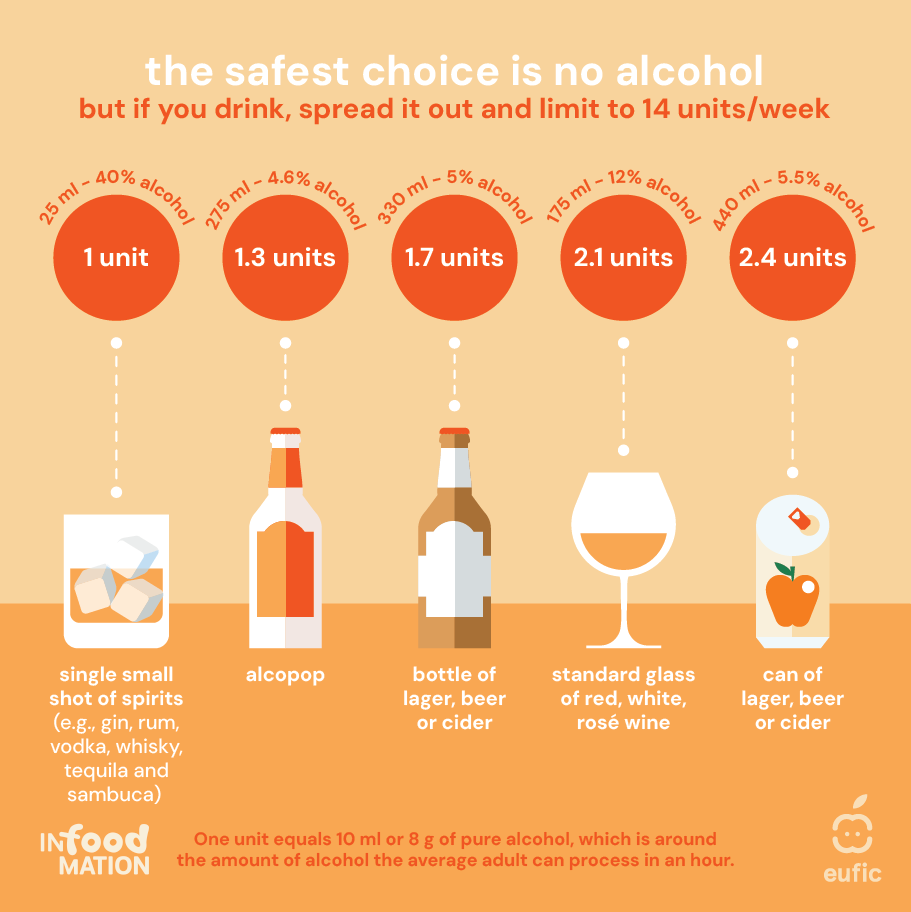
Figure 1. What are alcohol units?
References
- World Health Organization. (2024). Alcohol. Accessed January 28, 2026.
- World Health Organization. (2023). No level of alcohol consumption is safe for our health. Accessed January 28, 2026.
- Lippi G, et al. Moderate red wine consumption and cardiovascular disease risk: beyond the “French paradox.” Semin Thromb Hemost. 2010;36(1):59-70. doi:10.1055/s-0030-1248725
- Reynolds AN, et al. (2023). Saturated fat and trans-fat intakes and their replacement with other macronutrients: a systematic review and meta-analysis of prospective observational studies.
- Ferrières, J. (2004). The French paradox: lessons for other countries. Heart, 90(1), 107-111.
- Abreu S, Martins ML, & Morais C. (2025). Wine consumption and health: The dilemma. In Advances in Botanical Research (Vol. 113, pp. 235-266). Academic Press.
- Weiskirchen S & Weiskirchen R. Resveratrol: How Much Wine Do You Have to Drink to Stay Healthy? Advances in Nutrition. 2016;7(4):706-718. doi:10.3945/an.115.011627
- Hansen AS et al. Effect of red wine and red grape extract on blood lipids, haemostatic factors, and other risk factors for cardiovascular disease. Eur J Clin Nutr. 2005;59(3):449-455. doi:10.1038/sj.ejcn.1602107
- Fragopoulou E & Antonopoulou S. The French paradox three decades later: Role of inflammation and thrombosis. Clinica Chimica Acta. 2020;510:160-169. doi:10.1016/j.cca.2020.07.013
- De Oliveira e Silva ER, et al. Alcohol Consumption Raises HDL Cholesterol Levels by Increasing the Transport Rate of Apolipoproteins A-I and A-II. Circulation. 2000;102(19):2347-2352. doi:10.1161/01.CIR.102.19.2347
- Choi S, Park T & Je Y. Long-term alcohol consumption and incident health risk conditions related to cardiometabolic risk markers: A 20-year prospective cohort study. Addiction. 2025;120(9):1840-1852. doi:10.1111/add.70092
- World Health Organization. (2024). A rapid overview of systematic reviews on the effects of coconut oil intake compared with intake of other vegetable oils on mortality and cardiovascular health in children and adults.
- Bakht D, et al. Examining the French paradox: a systematic review of red wine consumption and cardiovascular risk. Ann Med Surg (Lond). 2025;87(12):8757-8769. doi:10.1097/MS9.0000000000004096
- Baxevanis GK & Kanellos PT. Red Wine Consumption and the Impact on Cardiovascular Health: The Methodological Barriers of Observational Study Design. Journal of Medicinal Food. 2024;27(11):1009-1017. doi:10.1089/jmf.2023.0054
- Lombardo M, et al. Health Effects of Red Wine Consumption: A Narrative Review of an Issue That Still Deserves Debate. Nutrients. 2023;15(8):1921. doi:10.3390/nu15081921
- Anderson BO et al. (2023). Health and cancer risks associated with low levels of alcohol consumption. The Lancet Public Health 8(1): e6-e7. https://doi.org/10.1016/S2468-2667(22)00317-6
- Department of Health (2016). UK Chief Medical Officers’ Low Risk Drinking Guidelines. https://assets.publishing.service.gov.uk/media/5a80b7ed40f0b623026951db/UK_CMOs__report.pdf
- Pérez-Jiménez J, et al. (2010). Identification of the 100 richest dietary sources of polyphenols: an application of the Phenol-Explorer database. European journal of clinical nutrition, 64(3), S112-S120.
- Deroover K, et al. (2021). A scoping review on consumer behaviour related to wine and health. Trends in Food Science & Technology, 112, 559-580.