From smaller portions to personalised feedback: new European toolkit shows practical ways to cut food waste
Last Updated : 19 October 2026
Brussels, 19 October 2026 — Food waste remains a major challenge across the EU food supply chain, with nearly 58 million tonnes generated each year. Many of the decisions that contribute to consumer food waste happen in everyday settings — at home, at work and in schools. The EU-funded COMBINE project explored how different interventions can be combined across these settings and has now translated lessons from 2.5 years of research and real-world trials into a practical European toolkit.
From 2024–2026, the COMBINE project carried out research and real-world interventions in schools, workplace canteens and households in France, Finland, Italy and Portugal. Among participating households, the interventions reduced food waste by an average of 28%, although results varied substantially. Across school and workplace canteen sites, results also varied considerably depending on the setting, intervention period and combination of measures implemented.
These results highlight why COMBINE recommends moving beyond generic awareness raising and instead identifying why food is being wasted in a particular setting, while combining communication with practical changes at the point where food choices are made.
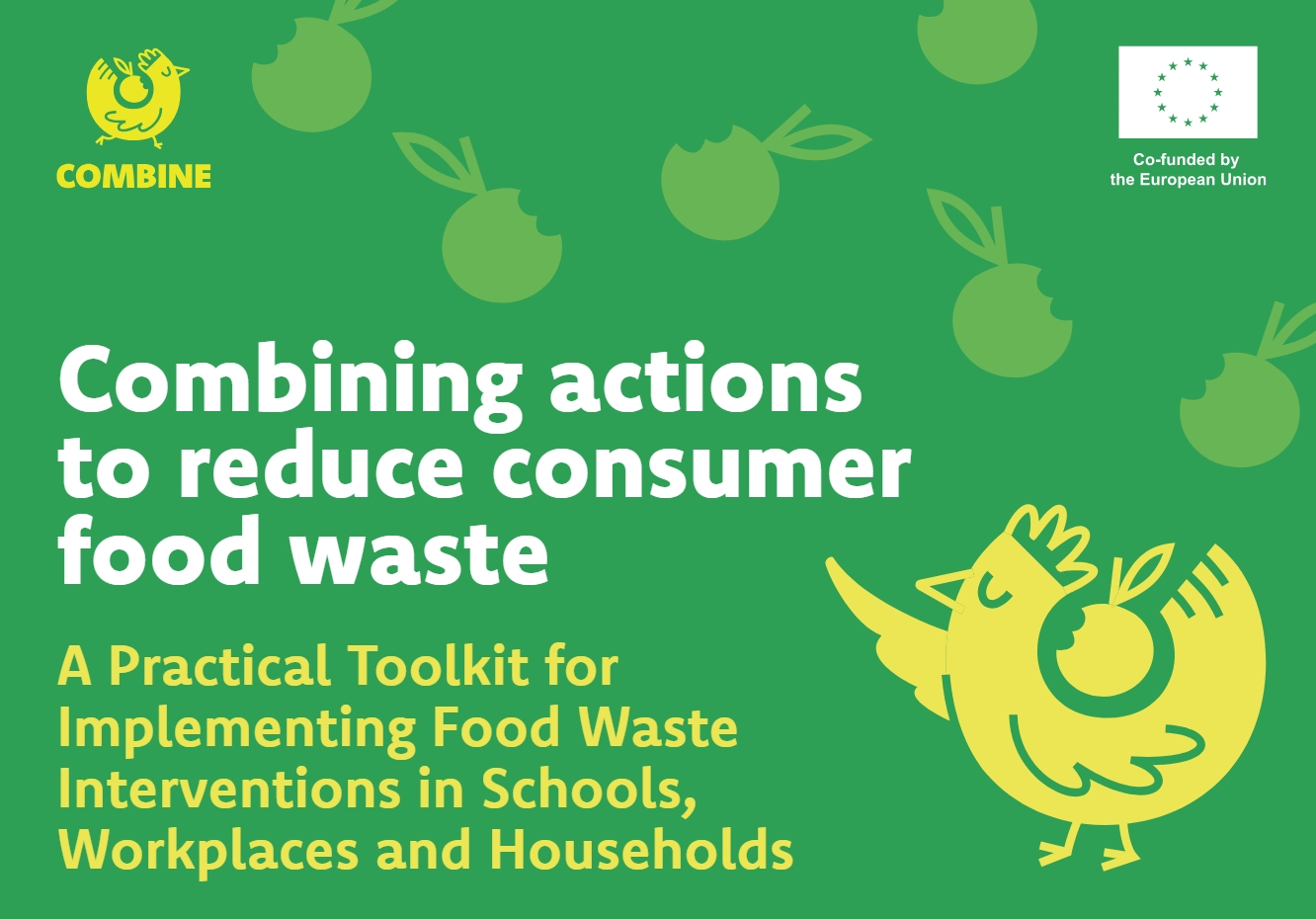
The practical replication toolkit, Combining Actions to Reduce Consumer Food Waste: A Practical Toolkit for Implementing Food Waste Interventions in Schools, Workplaces and Households, brings together interventions covering awareness raising, incentives, social influence, knowledge enhancement and nudges in canteens, alongside personalised household reports, newsletters and cooking workshops. Each intervention includes an explanation of how it works, examples from COMBINE sites and recommendations for selecting and combining measures in practice.
From smaller portions to personalised household feedback
The toolkit shows how food waste interventions can go beyond general awareness raising and be adapted to the specific reasons why food is being wasted in different settings.
In school and workplace canteens, examples tested through COMBINE included serving smaller portions by default while allowing diners to ask for more, displaying information about characteristics such as the spiciness of dishes before people choose them, and showing diners how food waste levels in their canteen were changing over time.
At one workplace canteen in France, vegetables were identified as the most-wasted food item, with poor perceived taste highlighted as an important factor contributing to waste. The intervention therefore included a culinary workshop for canteen staff and a commitment to serve at least one freshly cooked vegetable option at lunch every day.
For households, participants received personalised reports showing their food waste levels, the foods most commonly wasted and the main reasons for that waste. These findings were then used to identify relevant actions, supported through newsletters and cooking workshops.
Drawing on these experiences, the toolkit recommends first identifying the key drivers of food waste, keeping interventions practical and feasible, and combining different approaches to reach different groups. It also recommends pairing general awareness-raising activities with nudges and prompts at the point of food selection, prioritising targeted rather than generic communication, and involving consumers in the development of interventions.
For households, the toolkit recommends tailoring support according to people’s initial food waste levels and engagement, prioritising a small number of clearly defined actions, and focusing on simple, practical measures that can fit into busy lives.
“COMBINE showed that awareness on its own doesn't cut food waste,” said Stéphane Leroux, Executive Director of the International Food Waste Coalition (IFWC, part of WRAP Europe), which coordinates COMBINE. “What works is making the right choice the easy one, whether that's on the canteen line, in the school dining hall or at the kitchen table at home. By working across all three settings at once, we saw habits carry over from one to another, and that's the lesson we want others to take forward.”
Sharing the lessons from COMBINE
The COMBINE final event, held online via Zoom on 21 October 2026
(10:00 – 12:00 CEST), will bring together researchers, practitioners, policymakers and food waste experts to share what the project has learned and to discuss what is needed to take these approaches further.
During the event, COMBINE will present the toolkit and its findings, leaving room for discussion on its applications (see agenda here). Among the speakers, we count with the presence of:
- Prof. Dr. Erica Van Herpen, Professor of Resource-Smart Consumer Behaviour (Wageningen University)
- Dr. Katerina Palascha, Senior Research Manager at EUFIC
- Evangelos Genitsaris, ROSETTA Project Manager (Q-PLAN International)
- Julia Tanzer, FOLOUR Project Junior Consultant (Proman Management)
- Prof. Dr. Ludovica Principato, PERFETTO Project Associate Professor (Rome Tre University)
- Eunice Maria (Apprendizes School)
- Mari Kareinen (Sodexo)
- Gyula Kasza (Wasteless Foundation)
- Stephane Leroux (WRAP Europe)
The event is open to anyone working on or interested in food waste prevention, including local authorities, catering and canteen professionals, educators, NGOs and researchers.
Register here: https://us02web.zoom.us/webinar/register/WN_TX76f9llTRG_HcnDZX2Jsw#/registration
ENDS
Notes to editors
For interview requests or any other information, please contact Lorena Vargas (lorena.vargas@eufic.org) or Stephan Kampshoff at stephan.kampshoff@eufic.org.
The project's findings, tools and resources are available in open access on the Zenodo repository to support organisations and communities wishing to replicate the interventions. This includes methods from each site, covering documents such as surveys, interview guides, observation guides, plate waste measurements and more. COMBINE hopes this will help inform future work on scaling consumer food waste prevention across Europe.
Consortium partners
European Food Information Council (EUFIC) — Belgium
Kuluttajaliitto – Konsumentförbundet ry (Kulut) — Finland
Invento Innovation Lab Impresa Sociale S.R.L. (Invento) — Italy
WRAP Europe / International Food Waste Coalition (IFWC) — France (coordinator)
Universidade Nova De Lisboa (UNL) — Portugal
About COMBINE
COMBINE is a research project that is running from June 2024 – November 2026. It addresses consumer food waste across schools, workplace canteens and homes in France, Finland, Italy and Portugal.
The goal is to evaluate and implement effective intervention combinations that foster positive behavioural changes and reduce food waste. It aims to combine interventions targeted to specific consumer groups in schools, workplace canteens and homes, to resonate with consumers’ diverse environments and lifestyles and support the adoption of positive behavioural changes.
Contact
Project coordinator:
- Stéphane Leroux: stephane.leroux@wrap.ngo
Project communication:
- Stephan Kampshoff: stephan.kampshoff@eufic.org
- Darya Silchenko: darya.silchenko@eufic.org
Funding

This project has received funding from the European Union’s Single Market Programme Food Chain under Grant Agreement No. 101158394.