Healthy and sustainable diets: a guide for evidence-based reporting
Last Updated : 22 July 2026Reporting on healthy and sustainable diets can be challenging. The evidence is evolving, sustainability is multidimensional, and audiences often have competing priorities. This toolkit brings together the key scientific evidence, communication principles and practical reporting tips presented during the EUFIC training for journalists and science communicators.
1. Reporting checklist
Before publishing your story, ask yourself:
- Am I making sustainability concrete rather than abstract?
- Am I avoiding "vegan vs meat" framing?
- Am I explaining what scientists agree on and what remains uncertain?
- Am I helping readers understand what the numbers actually mean?
- Am I connecting sustainability with things people already care about (taste, cost, health)?
- Am I avoiding oversimplifying sustainability to carbon footprint alone?
- Am I giving readers realistic actions rather than idealised behaviour or only highlighting (climate) problems?
2. The science in 5 key messages & images
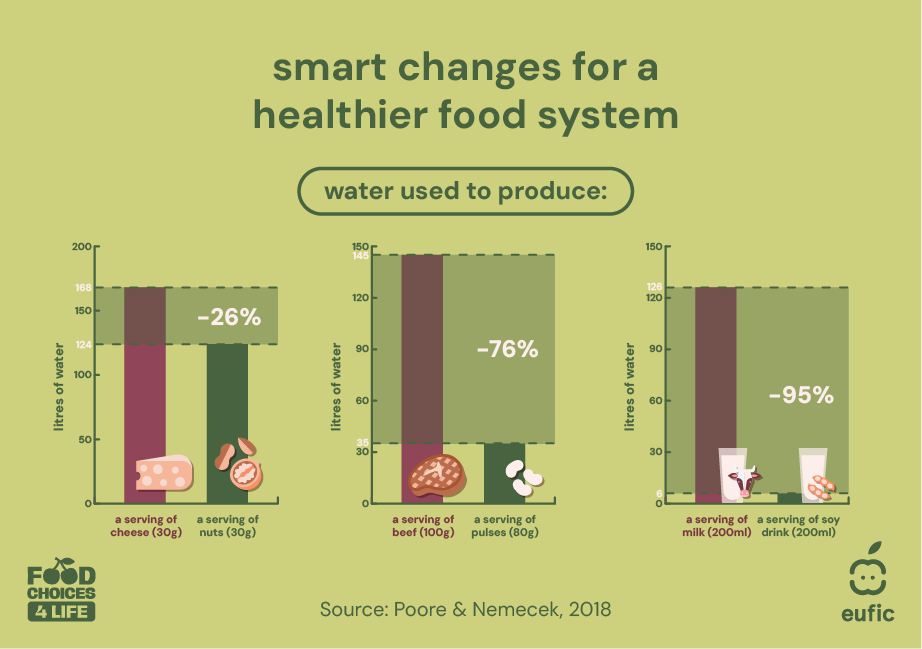
1. Small dietary shifts matter
Just replacing some meat, particularly beef and processed meat, with more vegetables, legumes and other plant foods can substantially reduce dietary greenhouse gas emissions and water and land use while supporting health.
Reporting tip: Two useful tools you can use to calculate and communicate the impact of small swaps are: Food Sustainability Tool & Climate change food calculator: What's your diet's carbon footprint?
2. Distinguish between differences within food categories and differences between them
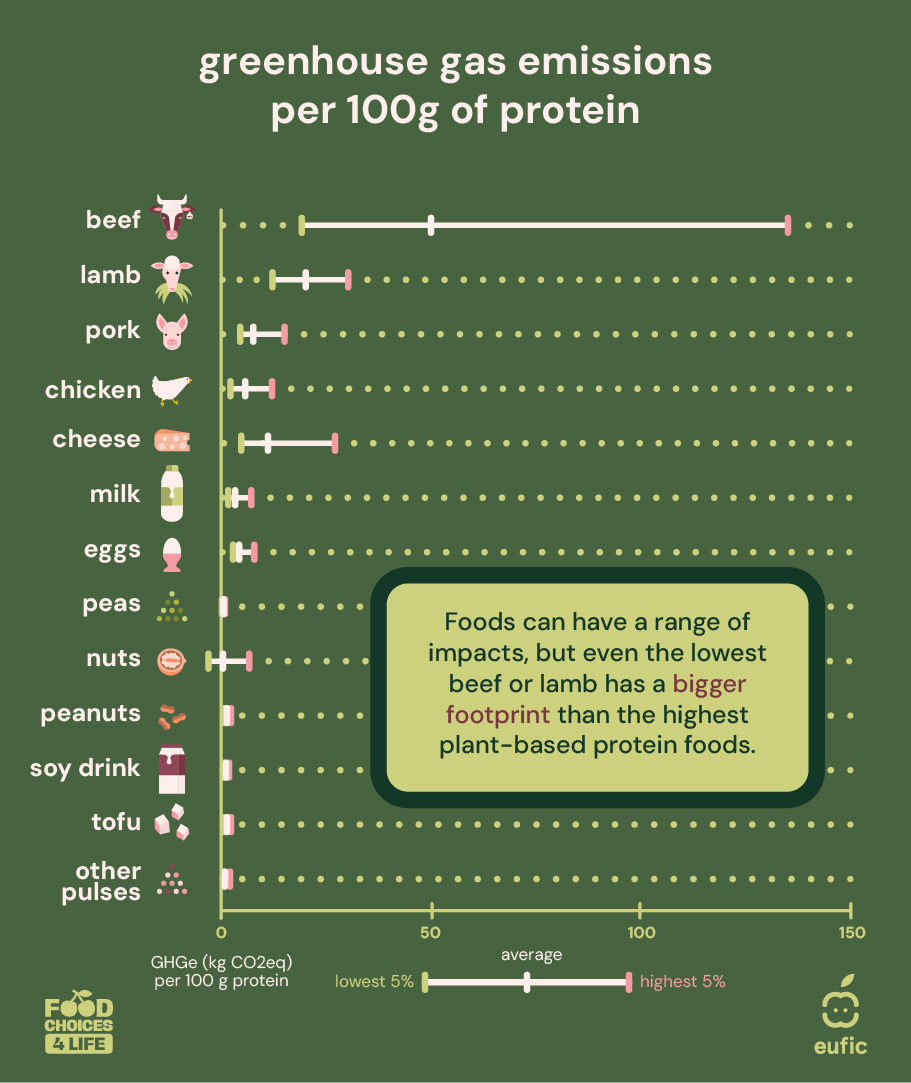
Production methods matter, but even the lowest-emission beef generally has a higher carbon footprint than the highest-emission plant proteins (e.g. beans). Make this context explicit to avoid overstating the climate benefits of "sustainable" beef.
3. What you eat usually matters more than where it comes from
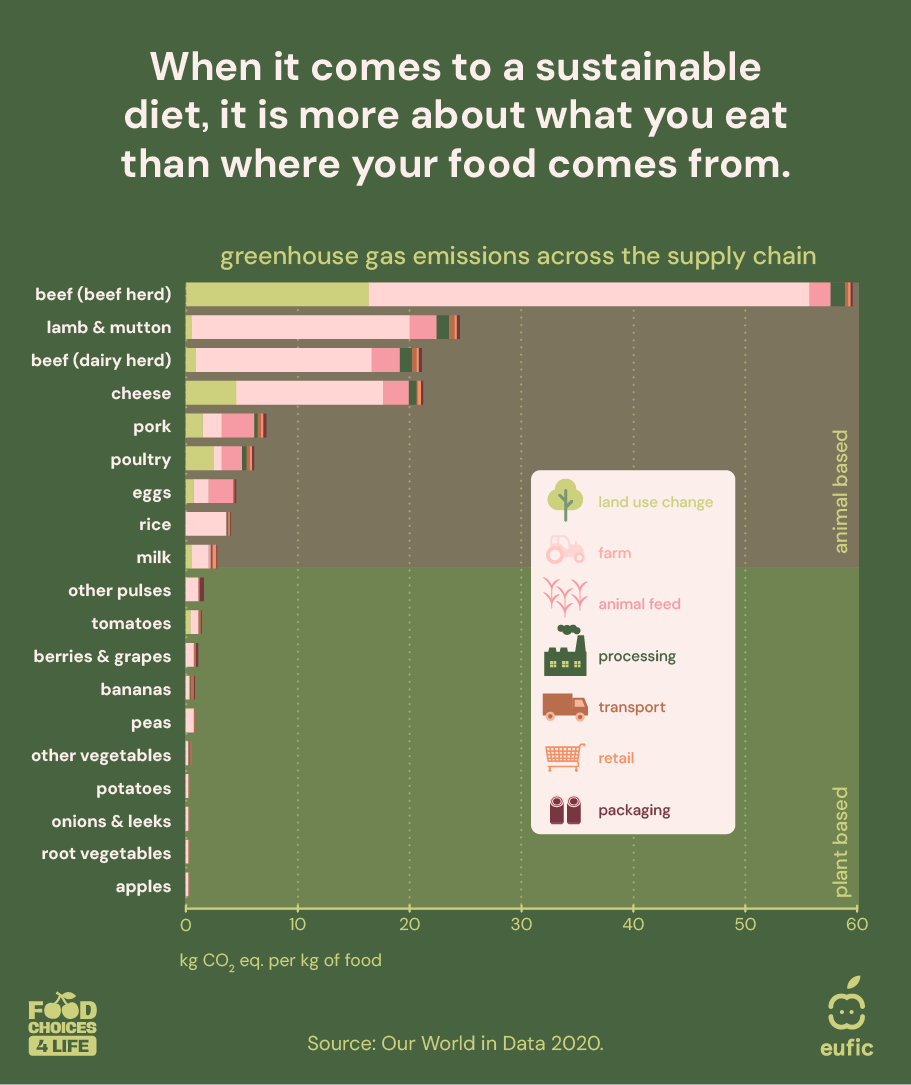
Transport contributes relatively little for most foods (unless it’s by plane!). Local foods can still provide benefits, but the biggest impact is at the production/farm level.
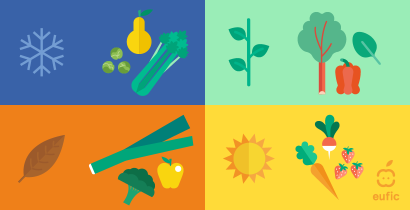
4. Seasonal often beats local
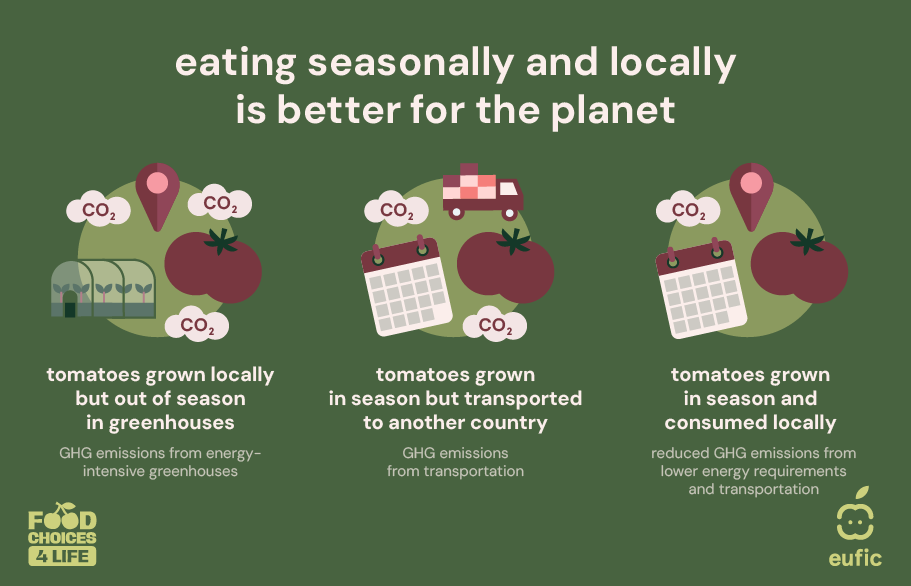
Locally grown produce that's out of season often requires energy-intensive heating or greenhouses, making it less sustainable than seasonal produce, even if it travels from farther away. The most sustainable option is to enjoy fresh produce when it’s in season locally or choose preserved forms such as canned tomatoes in winter, which are produced during peak season without sacrificing nutritional value.
5. Food waste matters
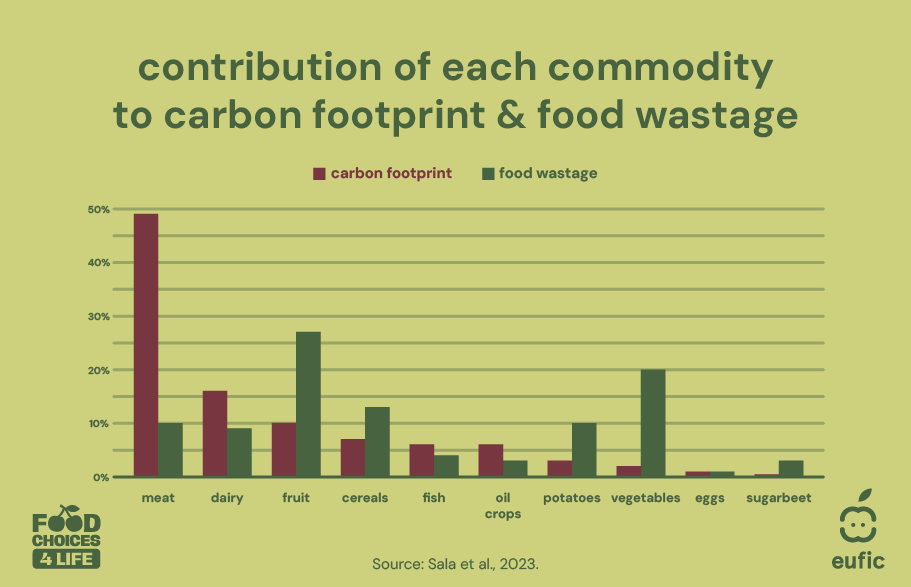
Not all wasted food has equal environmental impact. When we waste food, we waste all the resources that go into producing and transporting the food, which means that throwing away meat or dairy generally has a much larger climate impact than wasting vegetables.
3. Communicating sustainable diets effectively: top 10 tips
- Translate numbers into everyday meaning: Most readers cannot interpret an isolated CO₂ or water footprint figure. Whenever possible, explain what the number means in practical terms or compare it with something familiar.
- Lead with what matters to your audience: Environmental benefits may feel distant. Consider opening with benefits readers already care about (taste, affordability, convenience or health) before introducing the sustainability angle.
- Emphasise progress over perfection: Stories that present sustainable eating as a choice between "vegan" and "meat-eater" overlook the importance of gradual dietary shifts, such as eating more vegetables, legumes or seasonal foods.
- Be careful with labels: Terms such as "plant-based" may resonate less (or raise defensiveness) with some audiences than concrete, familiar language such as "seasonal vegetables", "beans and lentils", or "vegetable-rich meals".
- Don't let exceptions become the headline: Variation within food categories is important, but it should not obscure the much larger differences between food groups. For example, even relatively low-emission beef generally has a higher carbon footprint than most plant protein sources.
- Frame change as achievable: Research suggests people respond better to practical, incremental actions than to messages centred on sacrifice or restriction.
- Use examples readers can picture: Instead of describing "lower-impact diets" in general terms, illustrate what this could look like in everyday meals.
- Remember that food choices are rarely only about information: Price, taste, habits, convenience, culture and availability all influence what people eat. Good reporting reflects this wider context.
- Avoid searching for a single “most sustainable food”: Sustainable eating is about our overall dietary pattern rather than individual low climate-footprint foods.
- Explain trade-offs: some foods may have a lower carbon footprint but higher water use, or vice versa. Explain which environmental indicator is being discussed.
4. Reporting uncertainty
Uncertainty is a normal part of science, but not all uncertainty is the same. When reporting research, distinguish between:
- What scientists broadly agree on: Findings supported by consistent evidence across multiple studies.
- What is still being investigated: Questions where evidence is emerging or different approaches are being tested.
- Where findings may differ: Results that vary depending on context, population, production systems or methodology.
Reporting tip: Communicate uncertainty by following the structure of “Scientists broadly agree on X. Research continues on Y.” Instead of "Scientists are divided on sustainable diets", consider "There is strong scientific agreement that reducing the highest-impact foods can lower greenhouse gas emissions. Researchers continue to investigate the role of local sourcing, production methods and other factors that influence overall sustainability."
5. Tackling misinformation
When correcting misinformation, avoid repeating false claims more than necessary. Research suggests that corrections are more effective when they begin with the evidence, mention the misconception only briefly, and explain why it is misleading.
The Fact–Myth–Fallacy approach
- Start with the fact: always lead with the best available evidence.
- Briefly acknowledge the myth: Clearly signal that it is a misconception (e.g. "A common myth is..." or "You may have heard the misconception that..."). Avoid using the myth as the headline.
- Explain the fallacy: Help readers understand why the claim is misleading by explaining the missing context or faulty reasoning.
Example: “Most healthy dietary guidelines recommend eating more plant foods, but a common misconception is that sustainable eating means everyone must become vegan. This is not true. Evidence suggests that gradual shifts towards more plant-rich diets can substantially reduce environmental impact while accommodating different cultural and dietary preferences.”
6. Framing stories that resonate
How information is presented can influence how audiences interpret and engage with it. Research suggests that framing does not change the underlying evidence, but it can affect which aspects of a story people notice, remember and act upon.
Dynamic framing (focus on momentum)
People are often more receptive when they see behaviours as becoming more common. Showing that a behaviour is becoming more common can create a sense of momentum and make change feel more achievable.
Instead of "Climate change requires everyone to completely change their diets", consider “Many people are already making small dietary changes that benefit both their health and the environment" or “In the past 5 years we have seen a huge uptake of X behaviour”.
Reporting tip: Whenever trend data are available, consider reporting how behaviours are changing rather than only presenting a snapshot in time.
Social norms
People are influenced not only by what others do, but also by what others approve of. Highlighting support from trusted individuals or communities can help readers see sustainable behaviours as socially accepted rather than unusual.
Frame opportunities, not sacrifices
Sustainable eating is often framed around restriction ("eat less", "avoid", "give up"). Where appropriate, consider framing stories around changes (practical additions, substitutions or improvements) rather than loss. Connecting sustainability with things people already care about (taste, cost, health) is a great way to create engaging stories about sustainable diets.
Reporting tip: When writing headlines, ask yourself whether your framing highlights what people can do rather than only what they should avoid. People do not need perfectly sustainable diets. Small, realistic dietary improvements adopted by many people can have a greater population-level impact than large changes made by only a few.”
Extra resources
Articles:
- 9 practical tips for a healthy and sustainable diet
- Towards more sustainable diets
- What is a plant-based diet and does it have any benefits?
- Pulses (Q&A)
- How bad is eating (red) meat for our health and the environment?
- What happens when we reduce or stop eating meat? A micronutrient breakdown
- Are seasonal fruit and vegetables better for the environment?
- Explore Seasonal Fruit and Vegetables in Europe
- Food waste in Europe: statistics and facts about the problem
- How to reduce and avoid food waste at home
Infographics:
https://drive.google.com/drive/folders/1JNQD-kxt-2CsNHdwXOT_h6UJRKQtMBir?usp=sharing
Media enquiries
For interview requests, background information or additional materials, please contact EUFIC’s media team at media@eufic.org or EUFIC’s Media Manager.
Media Manager: Lorena Vargas
Email: Lorena.vargas@eufic.org
Phone number: +32 485 31 95 67
This guide was developed based on a training given for the FoodChoices4Life project. Read more about the project here: https://www.eufic.org/en/european-projects/project/foodchoices4life

Co-funded by the European Union. Views and opinions expressed are, however, those of the author(s) only and do not necessarily reflect those of the European Union or CINEA. Neither the European Union nor the granting authority can be held responsible for them.
This content follows our general terms of use.