Members Newsletter June 2026
Last Updated : 16 June 2026As we move into summer, this edition brings together EUFIC’s latest updates, resources and opportunities for members, from June webinars on microbiomes and consumer food waste to recent awareness-raising highlights on food and health information literacy and healthy habits. We also share updates from our Communication Lab on emulsifiers, new resources from EUFIC projects and initiatives, and news on upcoming projects. Also, to celebrate our 30th anniversary, we invite members to our Annual Conference and 30th Anniversary Celebration in Brussels this October.
News from EUFIC
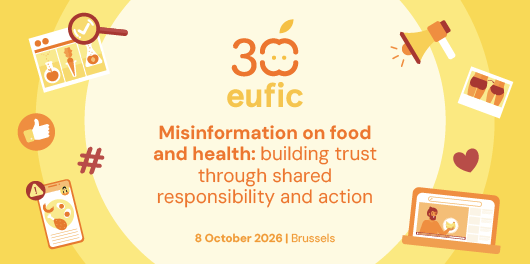
EUFIC Annual Conference & 30th Anniversary Celebration – 8 October 2026
This year marks a meaningful milestone for EUFIC: our 30th anniversary. To celebrate three decades of bringing evidence-based food and health information to the public, we will gather in Brussels on 8 October 2026 for our Annual Conference and anniversary celebration.
REGISTER TO OUR EVENT HERE. See programme agenda here.
(Please note that participation is limited to two representatives per organisation).
Under the theme “Misinformation on Food and Health: Building Shared Responsibility and Action,” the event will explore how misinformation emerges and spreads, its impact on public trust and health outcomes, and the role of digital platforms and AI in accelerating these challenges. EUFIC will also present its new seven-year strategy and position on tackling food and health misinformation.
- Date: 8 October 2026
- Place: La Bellone, Brussels
- Time: 09:00-16:00 (in person)
Autumn science communication trainings: registrations now open

After spring's success with over 60 experts trained, EUFIC has revamped its seven modules on food science communication to help food, nutrition, and health professionals translate complex scientific evidence into communication that is accurate, relevant, and trustworthy.
Whether you aim to strengthen public engagement, communicate more effectively, or build a credible presence on specific online platforms, our training focuses on one central objective: ensuring that robust science is both understood and trusted, without compromising scientific integrity.
Each session combines current research in science and health communication with practical examples drawn from campaigns, social media practice, and our three decades of experience in food science communication.
What was our team up to?

28 April – Laura Fernández co-chaired the Food4Health Strategic Board meeting and held conversations with key stakeholders like SCAR FS, ERA4Health, FutureFoodS, JRC, FAO, EIT Health, EIT Food, CECU, Newcastle University, UCD, and Wageningen University.
5 May – Stephan Kampshoff led a collaboration with PAN International, organising a hands-on communication training for healthcare professionals by reflecting on clinical scenarios.
6 May – Matteo Sabini attended a webinar about the Open Research Europe, the open access publishing repository created by the European Commission. The webinar explained the benefits of publishing scientific articles in this platform, that is free of charge for all beneficiaries of Horizon Europe projects.
12 May – Amber Peeters was asked to be part of the FEE Education Awards Panel, judging different lesson plans with the theme "Healthy people on a healthy planet: Transforming food behaviours for sustainability" and introducing the Award Ceremony
27 May – Betty Chang gave a presentation about EUFIC at UNIVET during a professional lecture and discussion with colleagues and students.
27 May – EUFIC led the Communication Lab #2 on emulsifiers, a specialised online workshop to co-create guidelines for media professionals covering food emulsifiers. Ten experts from EFEMA, IMACE, ICA, Cargill, Abbott, both Birmingham and Surrey Universities as well as Science Protect joined the team.
Building on findings from last November’s Communication Lab #1 on emulsifiers, participants used a structured Miro process to link specific scientific evidence—such as NOVA classification issues and recent gut microbiota studies—to real-world media barriers and constraints.
A key feature was the use of “persona cards” representing missing voices like journalists and patients, ensuring the proposed guidelines address actual information needs rather than just technical accuracy. The group produced a set of paired obstacles and actionable rules, alongside a “gap list” identifying questions requiring further public consultation. EUFIC is now synthesizing these results into a comprehensive report scheduled for publication in July 2026, that will be also shared among our members. The report aims to foster more nuanced, science-based media coverage that balances evolving knowledge with public health concerns.
The next Communication Lab round will be launched in October/November 2026. Topic is not yet defined, but we have a preference for:
- Micronutrient supplementation / food supplements and fortifications
- Fermented foods and microbiota
- Alternative proteins in the EU
Members are free to let us know their preference by sending us an email to EUFIC Membership Program.
4 June - Amber Peeters presented on a panel on meat reduction during a "Green Deal Eiwitshift" event organised by the Flemish Government
10-11 June – Debora Serra presented the poster session at the “Safe food, smart future: European innovations for a changing world” event, at the Wageningen University.
Membership news
2nd Members Meeting – EU-funded Projects
Thank you to everyone who joined our 2nd Members Meeting on 17 June!
As every year, the June meeting is dedicated to topics and opportunities arising from the EU-funded projects in which EUFIC is involved. This year, discussions focused on micronutrients, food marketing on social media, and promoting sustainable consumption choices, with contributions from experts from the European Public Health Alliance and Wageningen University.
We are involved in many more projects and initiatives. Our updated EUFIC Projects Portfolio provides an overview of opportunities and areas where members can engage or collaborate. Feel free to browse and share it within your organisation!
Finally, if you have any doubts or suggestions regarding EUFIC's strategy, you are welcome to contact us at strategy@eufic.org.
Any feedback on the meeting? Please, write to us or answer our survey here.
Welcome to our newest members: ICC & Barilla
We are delighted to welcome ICC and Barilla to the EUFIC Membership Programme.
ICC (International Association for Cereal Science and Technology) is an international network of cereal scientists and technologists from around the globe.
Barilla is a global food company known for its pasta, sauces and bakery products.
Both members join EUFIC with a shared interest in promoting evidence-based food and looks forward to engaging with our wide membership community.
New projects in the pipeline
NUTRIMIND
microbiome, NCDs, personalised nutrition
NUTRIMIND will deliver actionable, multi-disciplinary evidence on the complex interplay between dietary patterns, nutrients, and gut microbiome-host interactions in shaping mental health across critical life stages, from childhood to elderly.
EUFIC will coordinate this project, that aims to create a new dataset from clinical trial to understand the complex relationship between diet, gut microbiome and mental health, discovering the beneficial or detrimental effects of specific food beverages.
Our community of practice seeks to shape communication on microbiome and mental health, test and refining digital app for nutrition and health monitoring, participate in many co-design activities.
- Type of project: HORIZON RIA
- Project Manager: Giacomo Sini
Care4Food, a new project to reduce food waste at households' level
food waste
Good news! A new Horizon Europe project in which EUFIC is involved in was recently selected! Care4Food will deploy tools and activities to reduce the food waste at households’ level, also thanks to the development of awareness campaigns in 5 European region and 1 at EU-level.
EUFIC will be responsible for the communication activities and will support the development of the campaigns. The project is expected to start at the end of the year or in January 2027. We will provide more information to you soon!
Transforming agrifood systems through One Health approach and the use of AI: the Agrifood-OneAI is ready to start in September!
food system, policy & regulation
The implementation of One Health approach is challenged by institutional fragmentation, regulatory barriers, and a lack of data interoperability, which collectively impede effective risk management. At the same time, AI represents an opportunity to boost research and innovation and transform agrifood systems.
The Agrifood-OneAI project utilises artificial intelligence to accelerate the transformation of agrifood systems by operationalising (i.e. putting into practice) the One Health approach, addressing the growing demand for innovative tools that balance food safety, security, and sustainability amid climate and societal change. Funded by the COST programme, the project will build a pan-European network uniting academic, government, industry, and civil society stakeholders to map current initiatives, facilitate cross-sectoral collaboration, and leverage responsible and transparent AI tailored to agrifood challenges.
EUFIC is part of this network and will join the most relevant activities of the project in line with its long-term goals and its work on food safety.
Recent awareness-raising highlights
April 2026 – Navigate food & health information with confidence
consumer behaviour

- Article | Difference between correlation and causation (Infographic)
- Social Media | Have you seen these 3 nutrition superspreaders online before?
May 2026 – Build everyday healthy habits that support healthy ageing & non-communicable disease prevention
consumer behaviour, NCDs

- Article | What are the best ways to lose weight, according to science?
- Social Media | Are older adults getting enough protein every day?
Upcoming events
World Microbiome Day 2026 - Innovations from Soil to Shelf: Microbiomes Across Agriculture and Circular Food Design - 24 June 2026, 13:00-15:00 CEST (Online)
microbiome
Microbiomes influence every stage of the food system, from soil health and crop production to food fermentation and waste valorisation, and research in these areas is advancing rapidly. But often these areas are acting in silos with little interaction between. Celebrating World Microbiome Day, EUFIC together with speakers from the #Microbes4SustainableFoods cluster, is organising a webinar to create awareness about the important role of microbiomes for our food and highlight real-world microbiomes-based innovations for a more sustainable food system.
Registration available here.
This webinar offers a unique opportunity to gain first-hand insights into emerging microbiome innovations across agriculture, food production and circular food design. Participants will learn about the latest scientific developments, discover practical applications, and connect with researchers and professionals working across the microbiome ecosystem.
Réduire le gaspillage alimentaire des consommateurs : Résultats et outils du projet COMBINE – 25 June 2026, 11:00 – 13:00 (online)
food waste
Food waste remains a major challenge across homes, schools and workplace canteens, and effective solutions require a better understanding of consumer behaviour. But evidence on which combinations of interventions work best in different settings is still limited. Therefore, this webinar will present key findings, practical tools and lessons learned from the COMBINE project, which has tested and evaluated food waste reduction interventions across four European countries. As leader of the project's communication, dissemination and exploitation activities, EUFIC has played a central role in translating research findings into practical resources that can support wider uptake and replication.
Registration available here. (Please note that this webinar is in French).
Participants will gain access to insights on reducing consumer food waste, learn which interventions from the COMBINE project were most effective in schools, workplace canteens and households, and discover practical tools that can support future initiatives, policies or programmes. The webinar also offers an opportunity to exchange with experts and stakeholders working on food waste prevention across Europe.
Resources from our projects and initiatives
Water kefir as a model system for studying fermented foods
food processing, microbiome

Recently, water kefir has attracted growing research and industrial interest due to its potential and perceived health benefits. Owing to its increasing popularity, there is a growing demand for controlled and standardised production on an industrial scale. However, industrial-scale production remains a challenge due to the limited knowledge of the biological interactions of the microbial consortia and the lack of defined starter cultures. A new review from Domino’s researchers, published in Nature, explores water kefir as a model system for studying fermented foods using multi-omics and genome-scale metabolic modelling and discusses the regulatory challenges associated with the use of defined communities in food systems.
Read the full paper here.
New resource from the Microbiomes4Soy project (Microbiomes4Soy)
microbiome, food system
Microbiomes shape how our food is grown, how plants grow, and even how nutrients behave in the human body. The MICROBIOMES4SOY project is bringing these connections into focus across Europe. But these relationships are complex and still not fully understood. Hence, the project is combining experimental research in soil, plants, and nutrition to better understand how microbiomes support more sustainable and resilient food systems.
Recent work includes a collaboration with the MiCRop project at the Netherlands Plant Eco-phenotyping Centre in Utrecht, where researchers are jointly studying 100 soya bean soils from across Europe. This work helps reveal how different soil microbiomes can influence plant growth and nutrient uptake. And while parallel scientific reviews explore how soy interacts with the human gut microbiome and how plants and microbes jointly shape crop immunity, all outputs point towards the same idea: microbiomes matter across the entire food chain. EUFIC supports the communication and dissemination of MICROBIOMES4SOY results, helping translate complex science into accessible insights for stakeholders in nutrition, health, and food systems.
It provides early insights into how microbiome science may shape the future of sustainable agriculture, plant-based proteins, and nutrition, helping members stay ahead of emerging evidence in food system transformation.
Further reading: