What journalists need to know about vegan diets and colorectal cancer risk
Last Updated : 03 March 2026
Food and nutrition studies can be difficult to report on, often arriving with uncertainty, nuance, and pressure for quick headlines. These briefings are designed for journalists, breaking down what the research actually shows and providing clear context to support accurate coverage.
A large study has reported a 40% higher relative risk of colorectal cancer among vegans compared with meat eaters. This result may generate headlines, but it needs careful context. Here are the key points journalists should consider.
Quick summary
A pooled analysis of nine long-term cohort studies followed 1.8 million adults for about 16 years. Participants were grouped into five dietary patterns: meat eaters, poultry eaters, pescatarians, vegetarians, and vegans.
One result that may attract headlines is a reported higher risk of colorectal cancer among vegans compared with meat eaters.
However:
- The estimate for vegans was based on 93 colorectal cancer cases among ~8,800 people. Estimates based on small case numbers are statistically less stable and more easily influenced by random variation or chance differences.
- The study was observational, meaning it cannot establish cause and effect.
- When researchers excluded the first four years of follow-up (a standard sensitivity analysis), the association was no longer statistically significant. This suggests the finding is less robust than it might be implied by some headlines.
What do the results mean?
The reported hazard ratio of 1.40 means that the risk of colorectal cancer among vegans was estimated to be 40% higher than among meat eaters during the study period, after adjusting for factors such as age, sex and BMI.
This is a relative difference, not an absolute one. It does not mean 40% of vegans developed cancer.
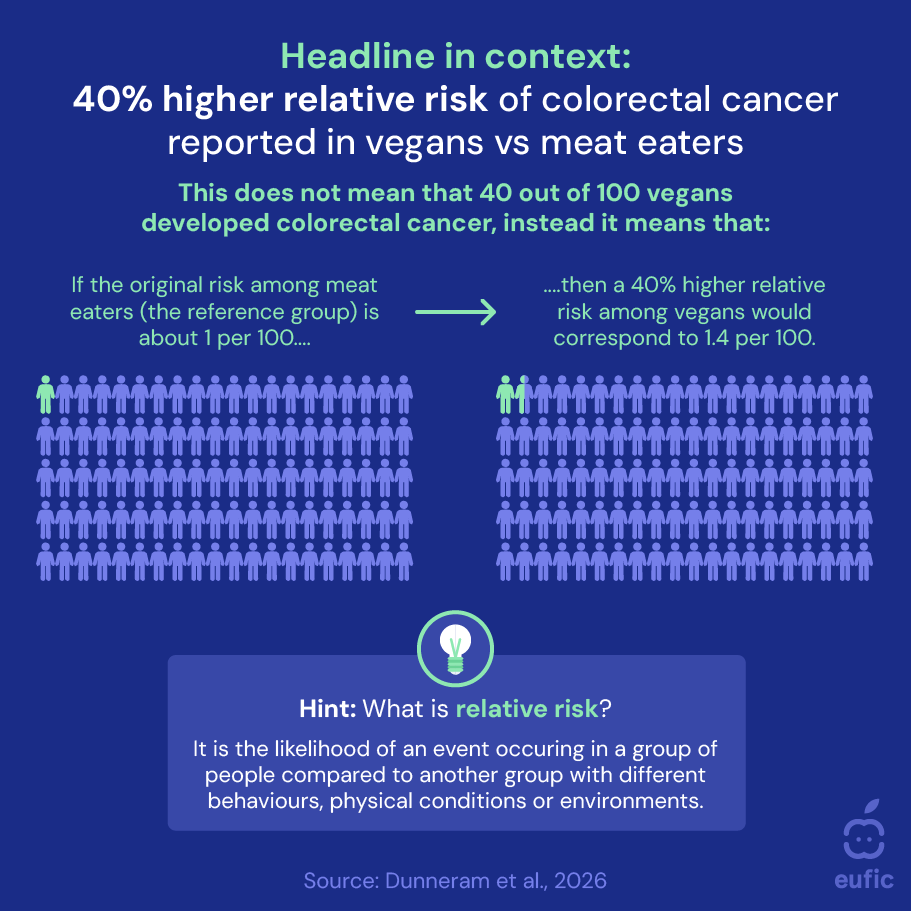
In this study, 93 out of nearly 9,000 vegans developed colorectal cancer over about 16 years — roughly 1 in 100 people. A 40% higher relative risk would translate to only 4 additional cases per 1,000 people over many years, not 40 out of 100.
Relative percentages can sound large, especially when the underlying number of cases is small.
Importantly, when researchers excluded the first four years of follow-up, a standard method to reduce the chance that early, undiagnosed illness influenced diet, the association weakened and was no longer statistically significant. This sensitivity analysis is central to interpreting the finding: it suggests the result may be less robust than headlines could imply. Researchers perform this type of analysis because early symptoms of a disease can sometimes lead people to change their behaviour before they receive a formal diagnosis, which can blur the direction of cause and effect. For example, someone developing early gastrointestinal symptoms might alter their diet, such as reducing certain foods or adopting a more plant-based pattern, in response to discomfort.
Vegetarians, who also avoid red and processed meat, did not show a higher risk of colorectal cancer. This makes the explanation unlikely to be as simple as “no meat equals higher risk.”
The study did not test possible biological explanations. For example, calcium intake, which may influence colorectal cancer risk, was not measured but mentioned by the authors of the study as a possible explanation. Other factors, including the relatively small number of cases among vegans or unmeasured lifestyle differences, could also have contributed to the result.
To keep in mind if reporting
- Study type: this was an observational study, so it cannot prove that a vegan diet causes colorectal cancer.
- Small numbers: the estimate for vegans was based on 93 cases, which increases statistical uncertainty.
- Result not robust: when the first four years of follow-up were excluded, the association was no longer statistically significant.
- Relative vs absolute risk: a 40% relative increase does not mean 40% of vegans developed cancer.The absolute difference was small.
- Diet measured once: diet was self-reported at the start of the study and may have changed over time.
- Diet quality not assessed: the study did not distinguish between whole-food plant-based patterns and diets high in refined grains, salt, added sugar and saturated fat.
- Broader evidence unchanged: international guidance linking processed meat to colorectal cancer remains unchanged.
What is the current scientific consensus on the topic?
No major international authority currently classifies vegan diets as a risk factor for colorectal cancer. Guidance continues to focus on limiting red and processed meat, maintaining a healthy weight, being physically active, limiting alcohol and eating fibre-rich foods (e.g., whole grains) and dairy products.1
This single finding does not overturn the broader evidence on processed meat and cancer risk.
| Authority | Position on red/processed meat and colorectal cancer |
| WHO / IARC | Processed meat classified as carcinogenic to humans (Group 1); red meat as probably carcinogenic (Group 2A), with strongest evidence for colorectal cancer. |
| World Cancer Research Fund (WCRF/AICR) | Strong evidence that red and processed meat increase colorectal cancer risk; recommends limiting red meat and avoiding processed meat. |
| European Code Against Cancer | Limiting red meat and avoid processed meat as part of cancer prevention. |
| European dietary guidelines | Many national European dietary guidelines recommend limiting red meat and eat little processed meat products, if any. For example, the UK dietary guidelines recommend no more than 70 g of red or processed meat per day.2 |
In depth
What the study showed
- Participants were categorised into five diet groups at baseline using food-frequency questionnaires:
- Meat eaters (reference): people eating red meat and/or processed meat (including processed red meat and processed poultry, but not processed fish). People’s processed meat intake ranged from 2 g/day to 20 g/day, with a median across the different cohorts of around 16 g/day. This is lower compared to other national figures, closer to 32 g/day.
- Poultry eaters: people not eating any red or processed meat but do eat poultry.
- Pescatarians: people not eating red meat, processed meat or poultry, but do eat fish.
- Vegetarians: people not eating red meat, processed meat, poultry, or fish, but do eat dairy products and/or eggs.
- Vegans: people not eating any animal products.
- The researchers tracked new cases of cancer over 16 years. For colorectal cancer specifically, the results were as follows:
- Vegans: had a 40% higher relative risk of colorectal cancer compared with meat eaters. This estimate was based on 93 cases among vegans, and the statistical confidence interval was wide. When the first four years of follow-up were excluded, the vegan–colorectal cancer association was attenuated and no longer statistically significant.
- Vegetarians: had a similar risk to meat eaters, the difference was small and not statistically significant.
- Pescatarians: had a lower relative risk compared with meat eaters.
What the study did not show
- A cause-and-effect relationship: as an observational cohort study, it cannot establish that a vegan diet increases colorectal cancer risk. Other factors could partly explain the observed difference.
- Generalisability to all vegans globally: most participants were from the UK and US; dietary patterns, fortification practices, and screening access differ internationally. Therefore, the results may not apply to vegan populations in other countries.
- Biological mechanism: the study did not test nutrient status (e.g., calcium, B12) or gut microbiome differences directly. Therefore, the research cannot explain why the association was observed, and no specific nutrient deficiency or biological pathway was identified. One possibility discussed by the authors is calcium intake. Calcium is thought to play a protective role in the colon because it can bind to bile acids and other compounds in the gut that might promote tumour development, reducing their potential harmful effects.1 Vegans, who avoid dairy products and other animal-derived sources of calcium, may have lower calcium intakes than vegetarians or meat eaters, which could potentially influence the colorectal cancer risk independently of meat consumption.
- Diet quality differences: it did not separate minimally processed plant-based diets from highly processed vegan diets. Therefore, the study cannot determine whether overall diet quality, rather than the absence of animal products, may have influenced the results.
- Stability of the finding: the association was not robust to all sensitivity analyses. When certain analytical checks were applied, the result weakened, suggesting the estimate may be less consistent and should be interpreted cautiously
How the research was done
- Sample: 1,817,477 adults from nine prospective cohorts; 8,849 were classified as vegans at baseline.
- Data collection: baseline food-frequency questionnaires assessing typical diet over the previous year.
- Outcome measurement: incident colorectal cancer identified through cancer registry linkage.
- Confounders adjusted for: smoking, alcohol, BMI, height, physical activity, diabetes, education, ethnicity, and other factors.
- Analysis: Cox proportional hazards models within cohorts, pooled via meta-analysis; sensitivity analyses excluded early follow-up years.
EUFIC resources available
- Red and processed meat and cancer risk — explainer on relative vs absolute risk
- Nutrients to consider in vegetarian and vegan diets (B12, calcium, iron, omega-3s)
Original paper: Dunneram Y, Lee JY, Watling CZ, et al. Vegetarian diets and cancer risk: pooled analysis of 1.8 million women and men in nine prospective studies on three continents. British Journal of Cancer (2026).